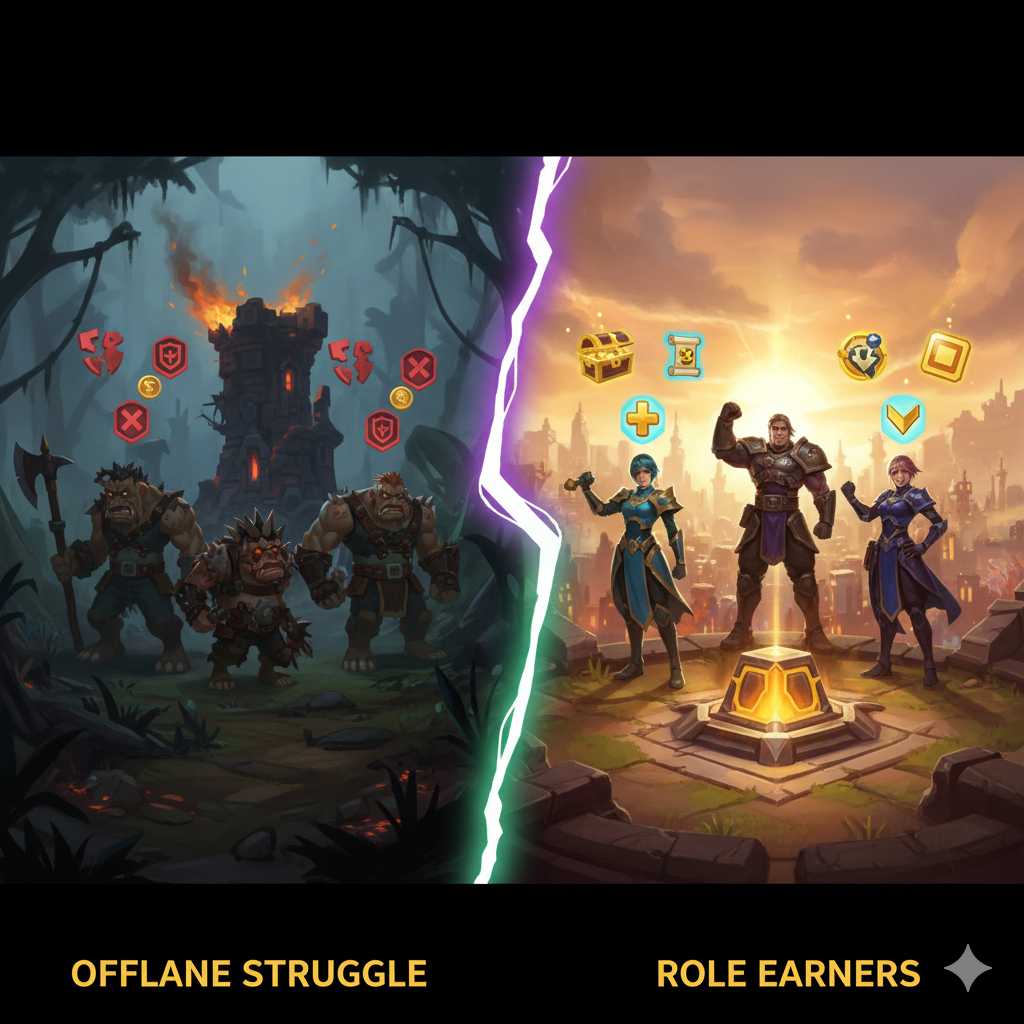
In ranked matchmaking in Dota 2 is facing a strange but very real shift. Queue times are rising, role balance feels uneven, and one role in particular is quietly becoming the most avoided position in the game: offlane. As a result, more players than ever are queuing for Role Earners instead of locking into fixed roles.
This isn’t about laziness or lack of skill. It’s about how Dota 2’s evolving meta, economy changes, and player psychology have made offlane one of the most demanding—and least rewarding—roles in solo queue. Understanding why this is happening helps explain not just queue behavior, but the state of ranked Dota itself.
What does offlane represent in Dota 2
Traditionally, the offlane was the role of sacrifice with purpose. You played under pressure, absorbed enemy attention, disrupted the carry’s farm, and still found ways to impact the mid and late game. Offlaners were initiators, aura carriers, tempo setters, and chaos creators.
The role rewarded:
-
Game sense over raw mechanics
-
Lane survival under pressure
-
Smart rotations and teamfight reads
In coordinated teams, offlane was one of the most respected positions. But solo queue has always told a different story.
How the meta made offlane harder than ever
Several changes have collided to make offlane especially punishing in ranked play.
Carries scale faster and more safely than in past years. Supports have more tools to protect lanes. Neutral camps, regen options, and early itemization favor defensive play. This means offlaners often struggle to pressure lanes the way they used to.
Instead of controlling the lane, many offlaners now:
-
Play defensively for long stretches
-
Fall behind in gold and experience
-
Depends heavily on team coordination to recover
When coordination is missing—as it often is in solo queue—the role feels thankless.
Why offlane feels worse in solo queue than in organized play
The offlane role is built around timing and teamwork. You create space, but someone else has to use it. You initiate, but someone else has to follow. You tank spells, but someone else has to deal damage.
In solo queue, those assumptions often break down.
Offlaners frequently experience:
-
No follow-up after initiations
-
Teammates are farming instead of pushing for advantages
-
Blame for lost fights despite correct plays
Even when you play well, the impact isn’t always visible on the scoreboard. That psychological disconnect pushes players away from the role.
The rise of Role Earners
Role Earners were designed to keep queue times healthy by encouraging flexibility. In , they’ve become a survival tool.
More players are queuing for Role Earner because:
-
Fixed-role queues often force offlane
-
Offlane games feel inconsistent
-
Role Earner allows escape from repeated offlane games
Instead of committing to a role they don’t enjoy, players prefer flexibility—even if it means playing something different every match.
This isn’t role dodging; it’s role fatigue.
Why players prefer earning roles instead of locking offlane
Locking into offlane today comes with risk. If the lane goes poorly, recovery is slow. If the team doesn’t cooperate, impact is limited. If the game is lost, the offlaner often becomes the scapegoat.
Role Earners, on the other hand, offer:
-
Variety across matches
-
Higher chances of core roles
-
Reduced burnout
Players aren’t avoiding responsibility—they’re avoiding repeat negative experiences.
Economic pressure: gold and XP feel worse in the offlane
One of the most searched questions is why offlane feels poor economically. The answer is simple: opportunity cost.
Carries and mids have clearer farming paths. Supports gain gold through stacking, wards, and assists. Offlaners often exist in between—needing items to function, but lacking a safe income.
If an offlaner misses one key timing, the role can feel useless for long stretches. In solo queue, teammates rarely adjust to compensate.
This economic fragility pushes players toward roles with clearer progression.
Mental strain plays a bigger role than balance
Even when offlane is technically balanced, it feels bad emotionally. Ranked players gravitate toward roles where effort feels rewarded.
Many players report:
-
Feeling invisible when offlane plays well
-
Feeling blamed when things go wrong
-
Feeling stuck in low-impact states
Over time, that mental strain outweighs balance discussions. Role Earners become a way to protect enjoyment.
Is offlane actually weak—or just misunderstood
This is where perspective matters. Offlane isn’t weak in a vacuum. In high-level coordinated play, it remains essential.
The issue is an expectation mismatch.
Solo queue offlane requires:
-
Accepting delayed impact
-
Playing for the team rather than self
-
Staying calm without recognition
Not everyone wants that experience every game—and that’s okay.
Why Role Earners actually help ranked health
While some see Role Earners as a problem, they’re quietly stabilizing matchmaking.
They:
-
Reduce forced offlane games
-
Lower queue frustration
-
Increase player retention
Instead of burning out offlane players, the system spreads responsibility more evenly.
From a long-term perspective, this keeps ranked healthier—even if it highlights role imbalance.
What Valve could do to improve offlane appeal?
Players aren’t asking for offlane to become overpowered. They want it to feel rewarding.
Common community hopes include:
-
Clearer gold recovery paths
-
Better recognition of utility impact
-
Slightly earlier item timings
Small changes could restore confidence without breaking the balance.
Advice for players stuck playing offlane
If you do play offlane, mindset matters more than mechanics.
Focus on:
-
Enabling one core consistently
-
Picking heroes with flexible builds
-
Communicating intentions early
Accept that not every game will feel great—but some will feel essential.
Final thoughts
The rise of Role Earners in Dota 2 isn’t a sign of player laziness or broken systems. It’s a reflection of how demanding the offlane role has become in solo queue.
Players still respect offlane. They just don’t want to live there every game.
In Role Earners, players are a pressure valve—allowing players to enjoy ranked without burning out on the hardest, most misunderstood role in Dota 2. Until offlane feels as rewarding as it is important, this trend isn’t going anywhere.