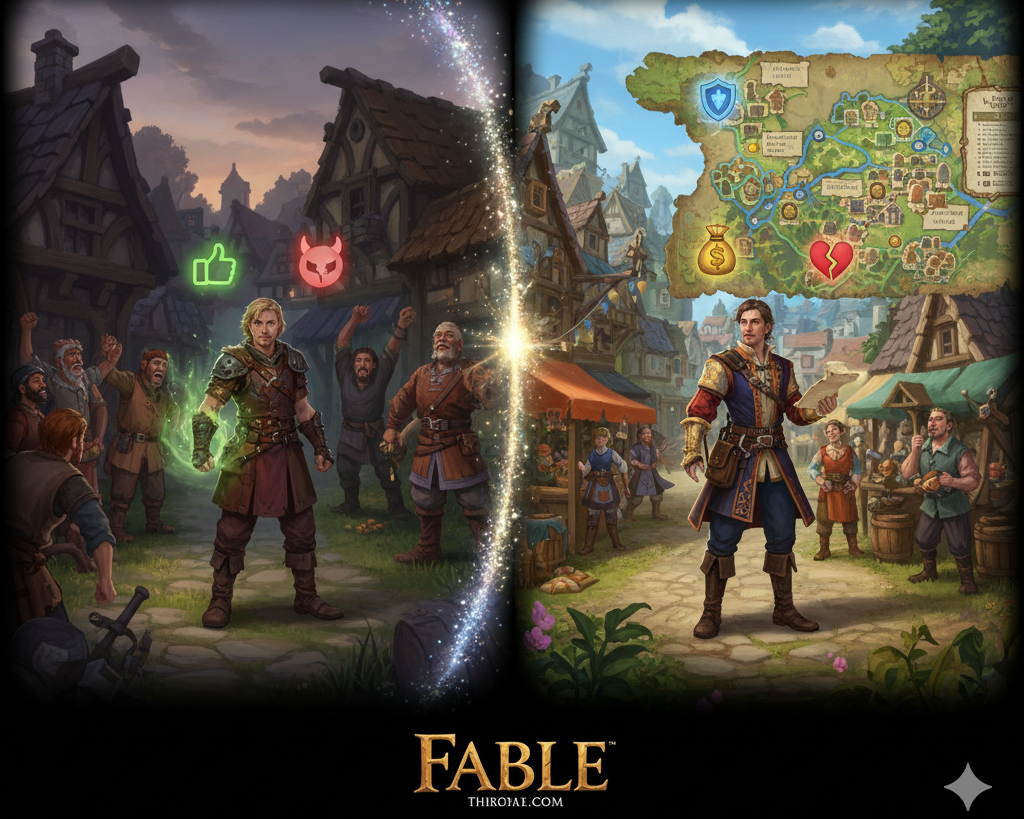
For nearly two decades, the Fable franchise was defined by a simple but iconic idea: you were either good or evil. Haloed saint or horned villain, Albion judged you globally, and the world reacted accordingly.
In the upcoming reboot, that system is officially gone.
Instead, Fable introduces a local reputation system, one of the most important design shifts the series has ever made. It’s subtler, more personal, and far more reactive. Players are no longer labeled heroes or monsters across the entire world. Instead, every town, village, and region forms its own opinion of you—based on what you do there.
This article explains how the new system works, why Playground Games replaced the classic morality scale, and what it means for role-playing, storytelling, and player freedom in modern Fable.
Why Fable Had to Move Beyond Good vs. Evil
The original Good vs. Evil system was charming and memorable, but it was also limiting. Once you crossed a certain threshold, your fate was locked in. NPC reactions became predictable. Choices lost nuance. You weren’t responding to situations—you were maintaining a moral meter.
RPG players expect more contextual storytelling. Being a hero in one place and a menace in another isn’t hypocrisy—it’s realism. Playground Games recognized that Albion feels more alive when people judge you by local experience, not global reputation.
The result is a system that prioritizes consequences over labels.
What Is the Local Reputation System?
Instead of tracking a single morality score, Fable now tracks regional reputation values. Each settlement remembers how you behave there.
Your actions influence:
-
How NPCs greet or avoid you
-
Prices in shops
-
Quest availability
-
Guard behavior
-
Rumors and dialogue
Helping a farming village doesn’t make you beloved in a city you’ve never visited. Likewise, committing crimes in one town won’t instantly brand you a villain everywhere else.
Albion doesn’t gossip globally anymore—it remembers locally.
Reputation Is Built Through Patterns, Not Single Choices
One of the biggest changes players notice is that single actions rarely define you. The new system looks at patterns.
For example:
-
Stealing once might raise suspicion
-
Stealing repeatedly marks you as untrustworthy
-
Helping NPCs over time builds genuine respect
-
Violence may be tolerated in rough areas but condemned in peaceful towns
This prevents exaggerated reactions and encourages consistent role-play. You’re not instantly a villain for one bad decision—and you can recover your reputation through effort, not meter manipulation.
Different Regions, Different Values
Not all regions judge you the same way.
A rough port town might respect intimidation and strength. A wealthy city may value lawfulness and generosity. A remote village might care more about protection than morality.
This means:
-
The same action can produce different reactions
-
Your reputation isn’t “right” or “wrong”—it’s contextual
-
You must read the room before acting
In practice, this makes Albion feel culturally diverse rather than morally binary.
How NPC Behavior Changes With Reputation
NPC reactions in ’s Fable are more subtle and dynamic.
Instead of exaggerated animations, you’ll notice:
-
Tone shifts in dialogue
-
Body language changes
-
NPCs refusing help—or offering it
-
Guards escalating faster in hostile regions
Importantly, some NPCs will pretend to be friendly while actively undermining you if your reputation is poor. Trust is no longer guaranteed.
Crime, Justice, and Reputation
Crime no longer affects a global morality bar. Instead, it damages your reputation where it happens.
Steal in one town, and guards there remember you. Leave the region, and you’re unknown again—but returning later may trigger delayed consequences.
This allows:
-
Crime-focused playstyles without worldwide punishment
-
Regional “wanted” behavior
-
Redemption arcs that feel earned
Importantly, paying fines or serving punishments doesn’t magically erase reputation. Actions carry memory.
How This Changes Quest Design
Quests are no longer purely moral tests—they’re relationship tests.
Some quests only appear if:
-
A town trusts you
-
You’re feared
-
You’re considered neutral
Others change tone based on your reputation. The same quest might offer different rewards, endings, or NPC outcomes depending on how that region sees you.
This massively increases replay value without forcing binary choices.
You Can Be a Hero and a Villain—At the Same Time
Perhaps the most exciting aspect of the new system is freedom.
You can:
-
Protect villages and exploit cities
-
Be honorable publicly and ruthless privately
-
Build myths that contradict each other
NPCs won’t argue about who you are—they’ll speak from experience.
You’re no longer a morality icon. You’re a rumor.
Why This Fits Modern RPG Design
Modern RPGs thrive on player expression. Systems that lock players into rigid moral categories limit creativity.
The local reputation system aligns Fable with contemporary design philosophies:
-
Consequence-driven storytelling
-
Environmental memory
-
Player-defined identity
It respects the player’s intelligence instead of simplifying morality.
What About Classic Fable Humor and Tone?
Goodbye, Good vs. Evil doesn’t mean goodbye charm.
The new system actually enhances humor. NPCs might praise you while locking their doors. Town criers may exaggerate your deeds differently in each region. Conflicting reputations create ironic moments classic Fable fans will love.
It’s still whimsical—just smarter.
Common Player Concerns (and Why They’re Likely Unfounded)
Some fans worry that removing Good vs. Evil removes identity. In reality, identity becomes stronger.
Instead of one label, you build:
-
Multiple reputations
-
Regional legends
-
Conflicting stories
You’re not losing clarity—you’re gaining depth.
How Players Should Approach the New System
The best advice for Fable players is simple: stop min-maxing morality.
Play naturally. Accept consequences. Let regions react differently. Don’t try to “fix” your reputation everywhere—embrace inconsistency.
Albion remembers what you do, not what you intend.
Final Thoughts
The removal of Good vs. Evil is not the death of Fable’s identity—it’s its evolution. The new local reputation system transforms Albion into a world that judges you not as a symbol, but as a presence.
You are no longer a glowing hero or a horned villain.
You are a story—told differently everywhere you go.
And in , that makes Fable more alive than it has ever been.